Yellowstone
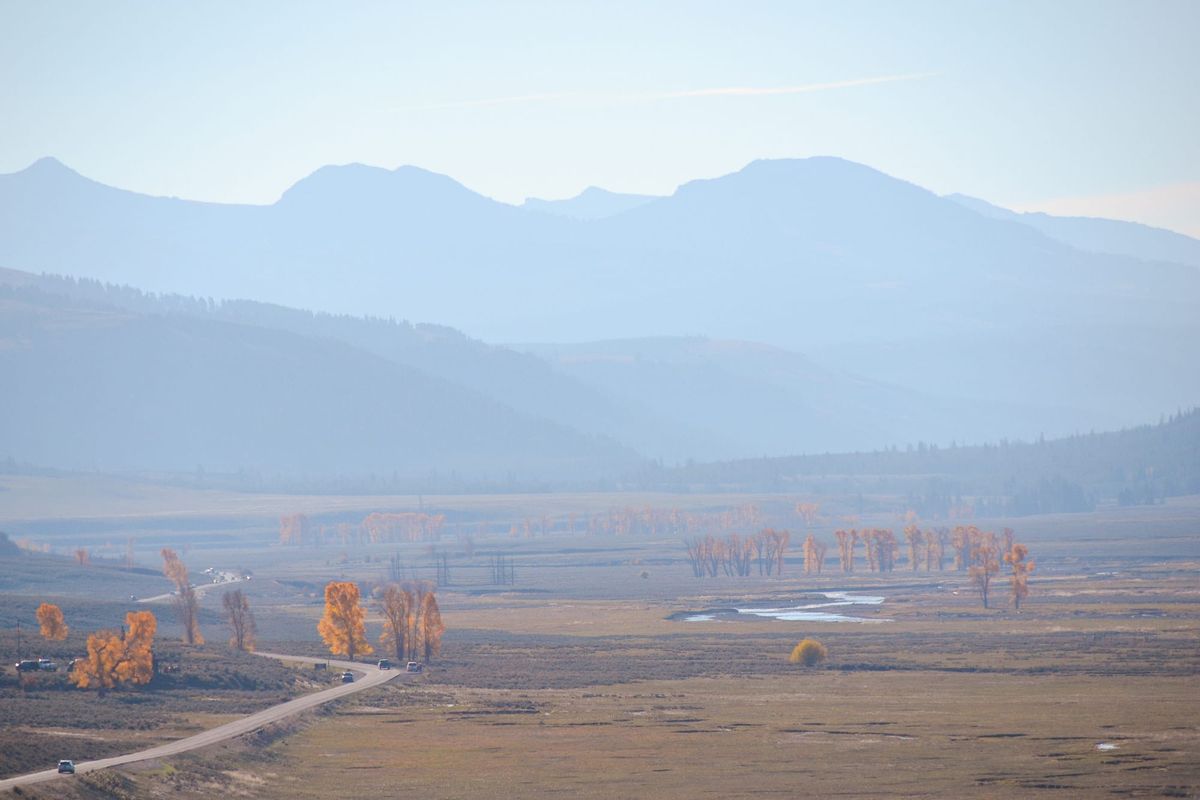
When you travel back in time, literally, it lends a day to being an eventful one. On the morning of October 4th, I awakened at 4:30 to total darkness and the time pressure of getting to the airport. My eyes carried the baggage of four and a half hours of sleep while my husband carried our large, shared, checked bag to the car. In the hopes of falling back to sleep once we boarded our flight, I promised myself I’d wait to have a cup of coffee until we reached our connection in Chicago. Successful in my endeavors, however unsuccessful in getting some more shuteye, I waited in the Dunkin Donuts line to have a few sips of the medium coffee I couldn’t have possibly finished before boarding the flight to Bozeman. Despite the day of travel, arriving before noon left us with daylight to drive two hours south to Island Park, Idaho. By now, I’d managed to enjoy a cup of coffee. Losing service and sun as it began to lower behind the Yellowstone National Park sign, we made our way into the 3,472 square miles of natural wonders from the west entrance of the park.
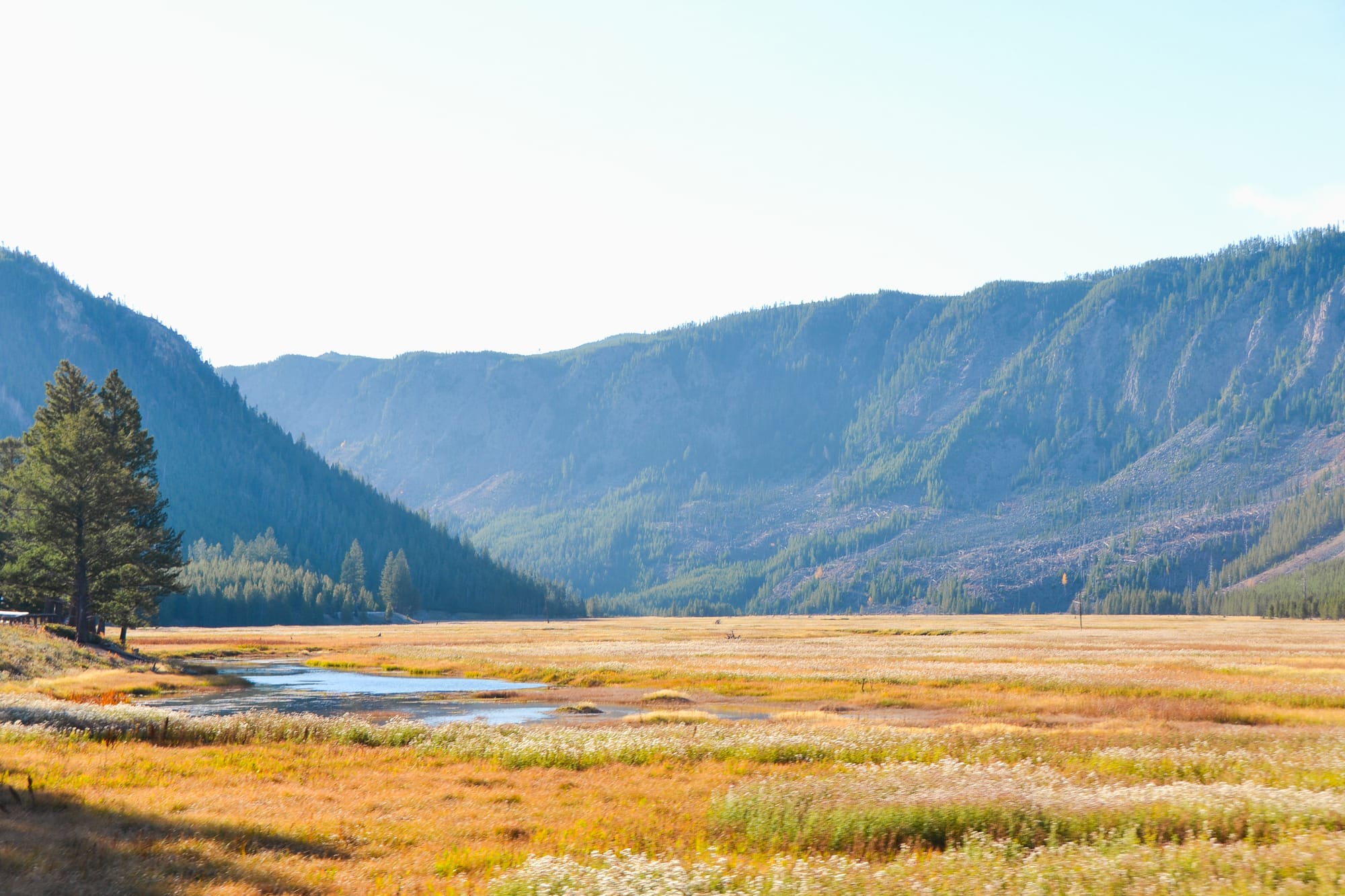
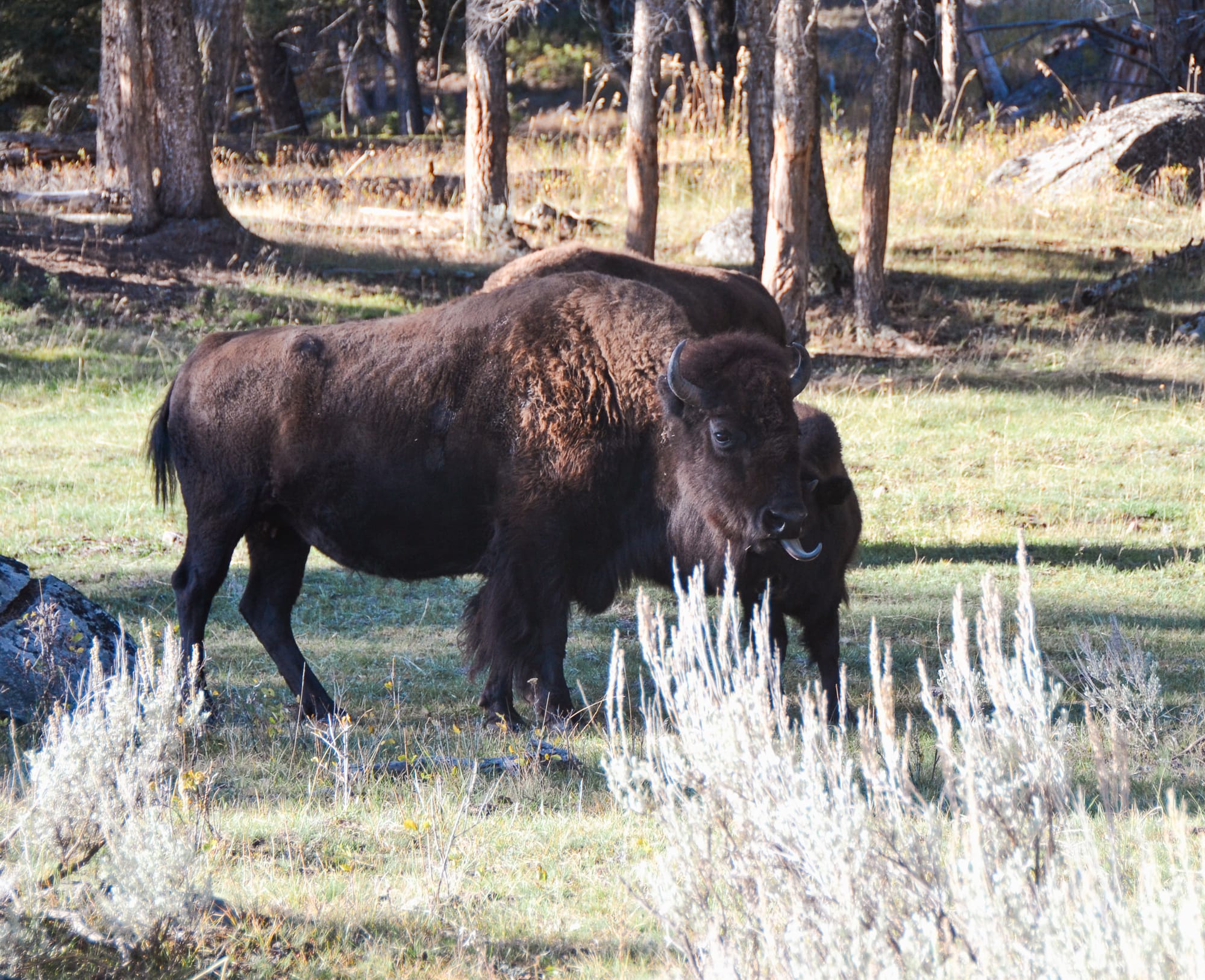
It was increasingly difficult not to realize my own smallness, yet significance, when standing under the canopy of shadows delivered by mountain peaks. Maybe it’s the human in me that wants to attribute meaning to my experiences, and thus, inherently believe that my own being has some meaning to greater existence, but my smallness, as it’s shaped by the vast landscape that’s sprawled out before me, is comforting. It makes me consider, even more so than I have, that the whole point is to interact with life itself. I hope the bison understand I’m smiling at them out of admiration, even if it might be masked by a fear of them charging at me. I hope they can read the vibe. Whatever may be the truth about existence and life itself, nature is a force to be reckoned with.
We spent our first evening in the park walking the Fountain Paint Pot trail and, by mere minutes, missing the last daylight eruption of the timely Old Faithful. Since it is guaranteed to go off within the next 90-120 minutes, we stayed and walked around the Upper Geyser Basin, home to the highest concentration of active geysers in the world. In my observing the awe of the natural world, I couldn’t help but notice how careless some people were on the boardwalks, as if the geysers weren’t hundreds of degrees and if you fell in, you weren’t going to be saved out of precaution for your knight in shining armor. Really, though, it was almost as if the geysers were an attraction at Disneyland. Not to mention the woman I watched get quite close to a bison with her small child pushed out in front of her in a stroller while her eldest was doing cartwheels like the bison was an animal at the zoo bounded by some invisible cage. I don’t think you want to find out what happens if you end up sharing breathing air with a bison or find yourself in a boiling bath. Eventually, the time would come to gather around on the wooden benches, bison grazing on the land behind us, as we’d watch Old Faithful erupt with stars in the sky and the faintest blue left on the horizon.
At the time of this writing, a Super El Niño is growing to be one of, if not the, strongest on record. Meanwhile, I am waltzing around on an enormous supervolcano that, if it were to erupt, would threaten civilization. However, the eruption window for this event happening is roughly every 725,000 years, and we are still 100,000 years from that happening. So, it seems unlikely. Nonetheless, the hundreds of geysers that encompassed me were a constant reminder of the enormous pressure building beneath my feet. The thing about nature is that it knows what it’s doing, because it has to interact appropriately with the conditions in which it finds itself. We humans, though, seem to be disconnected from our own nature, and the natural world at large. Perhaps it coincides with the loss of relationships, as loneliness continues on an uphill trend, and therefore fewer people have people to help them make sense of themselves, or sense of it all. It is through our relationships that we understand one another, and that the reality of life is brought to the forefront because we care about the lives of others.
The truth is that we cannot escape our very nature, which is intrinsically linked to the natural world. Walking around Mammoth Hot Springs will compel you to consider how much grander the natural world is beyond our species, who’ve only been on Earth the last 300,000 years, which is only about .002% of the time the dinosaurs were, and roughly .007% of Earth’s history. We are small, and that’s okay. In fact, I think that’s good. There is a sense of peace you can obtain with this understanding. However, it is quite worrisome that some people do not agree with this and would instead choose to assert dominance. I think it is worth considering that when a few people assert dominance, it means the survival of those few people.
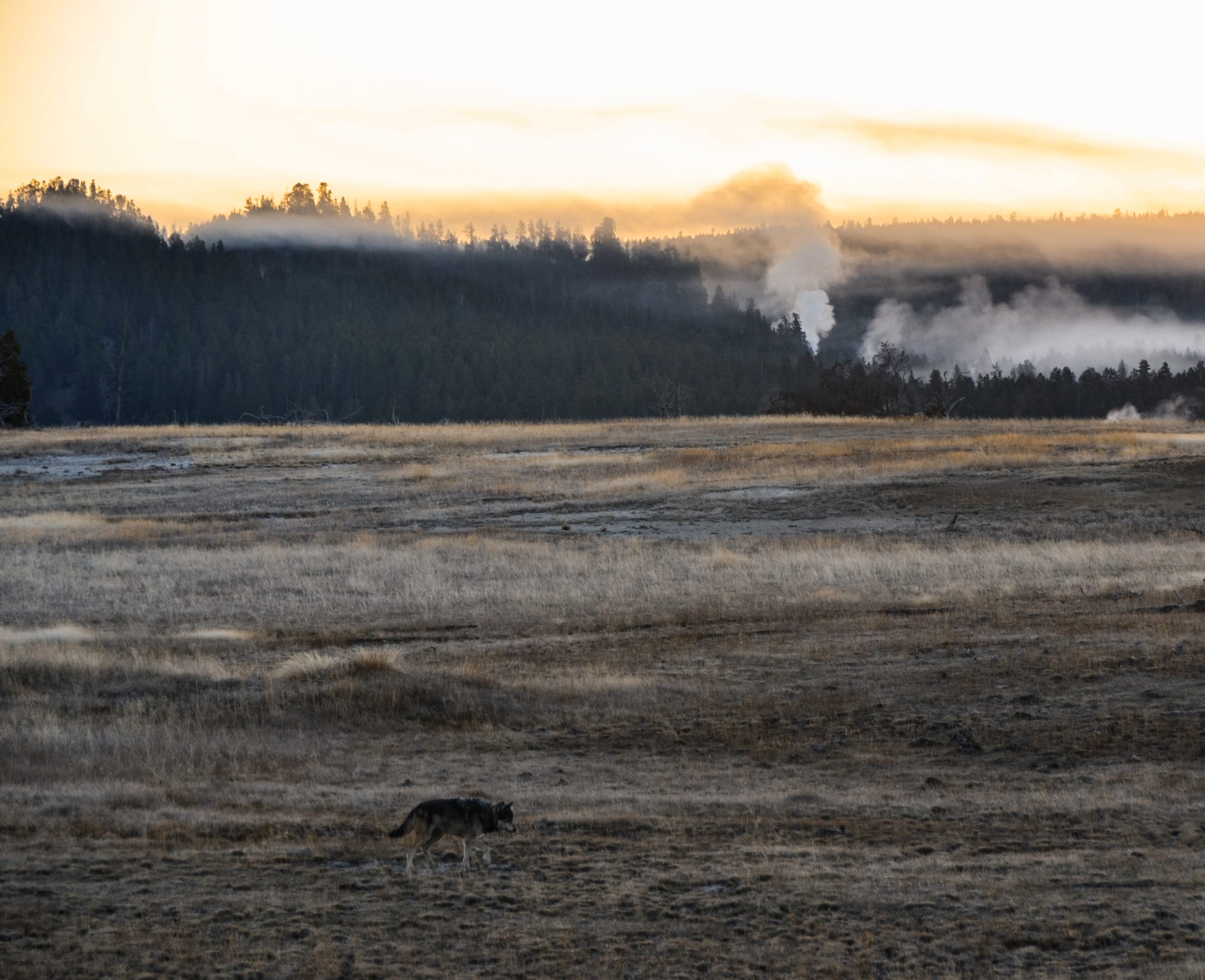
Halfway through our trip, we embarked on a wildlife tour. For someone who rarely wakes up before 7:30, waking up twice in one week at 4:30 was an effort for my tired eyes. Our first stop led us to see two wolves as they awoke from their slumber. In the quiet morning hours, a dozen photographers and the 7 of us stood 100 yards from two members of the Junction Butte pack as they made their morning calls. Yellowstone is home to at least 80 wolves organized into packs and are more likely to be killed by rival packs than they are by age or disease. The wolves, like us, seek survival, and fights amongst the packs are typically over resources and territory, also like us. It appears that we do not stray from these instincts that we share with wolves.
The evening prior, we brought our tired and hungry bodies to the Yellowstone Beer Company. There, I’d have the Ojo Caliente, a stout that now sits at the top of my list. Don’t find much prestige in my ranking, though; my “beers I’ve tried” list is short but maturing. What I couldn’t help but notice was a painted wall that read, “history is the narrative of people searching for a place to go.” I found this to be a clever framing. We’ve been expanding our dominance over nature, and not in a kind or respectful manner, for hundreds of thousands of years. It wouldn’t be until the next day, at the end of our wildlife tour and after consuming the best sandwich for hiking there is, a PB&J, that our guide would tell us the story of John Colter. A man who’d explore Yellowstone in the early 1800s and share his stories, only for them to be met with disbelief. As he ventured through the land, he was aided by the Native Americans who had lived in the region for thousands of years. Not long after the first encounters, many tribes lost their land as it had been restricted by federal treaties, and in 1872, Ulysses S. Grant made Yellowstone the first national park. By 1900, all the tribes had been forced onto reservations. Grant declared it a national park to protect it, yet the native people had been protecting and living with the land for centuries.
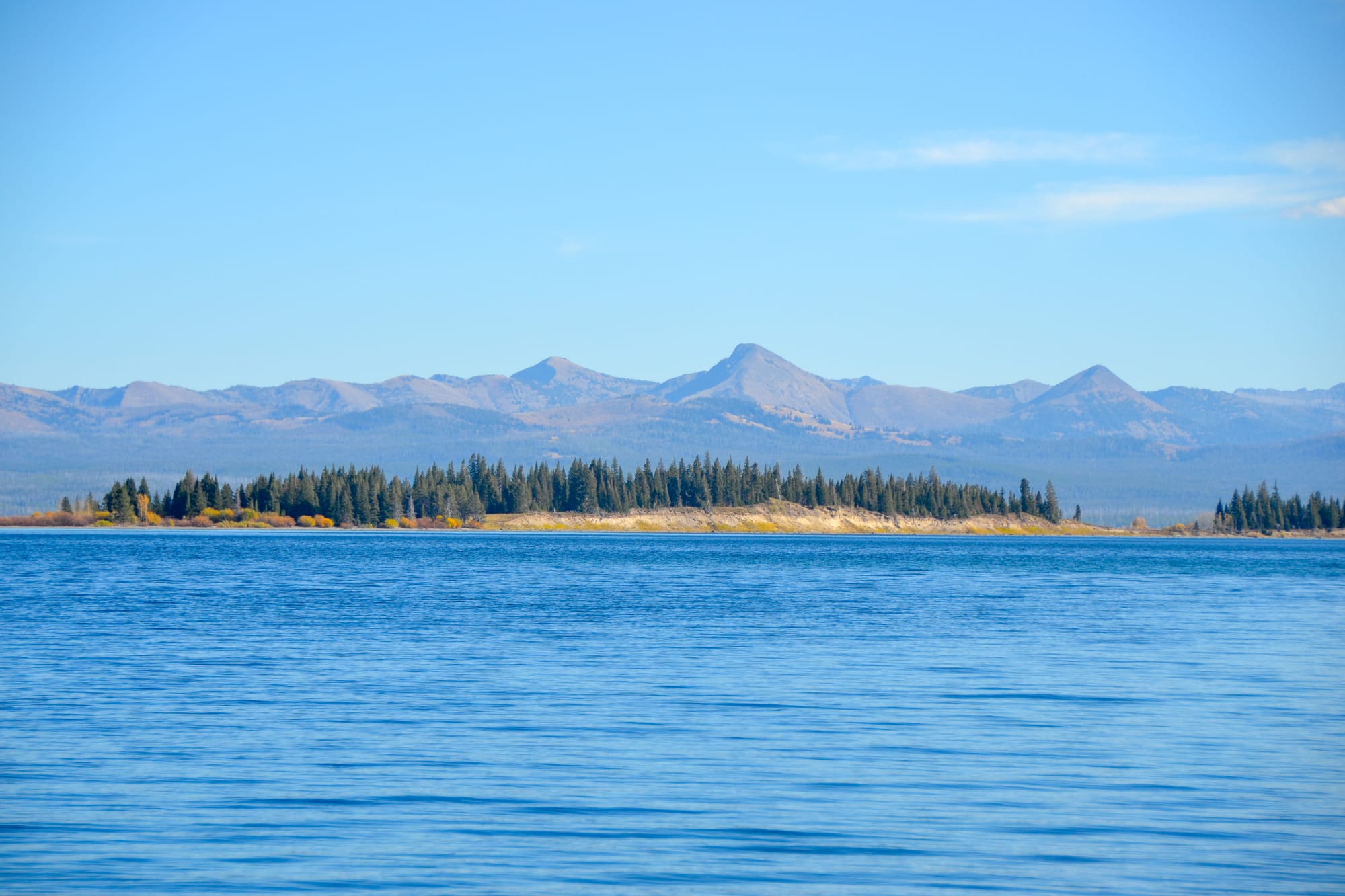
When you are completely immersed in nature, you cannot help being confronted by it and all its beauty and power. It is incredible to think that we are a part of this natural world, living it out in our own form. We, as homo sapiens, are but one expression of natural evolution. But isn’t there something unique or special about us? Well, isn’t there something unique and special about all living things, and all natural processes? Who are we to decide the fate of everything? We argue it’s our intelligence that sets us apart. But is this not the same intelligence that continues to make conscious efforts towards our own self-destruction? I’d say that the time for a collective understanding that nobody is above the forces of nature is now. That this tipping point in modern globalization is beckoning us to put humanity as a whole over the countries that divide us and decide once and for all what our human nature is. Will curiosity kill the cat?
Amusing is one way I might describe the present day; however, it does not adequately describe how it feels. Nonetheless, when everything seems so logically catastrophic, like whether AI will destroy us all in the next 10 years (or less), if we will destroy ourselves with war, or if we will ultimately succumb to nature’s forces, it makes everything feel so overwhelmingly immaterial. It only leads me to wonder why we don’t behave more prudently when the stakes on all fronts appear so high. The incorporeal feeling of modern life in America is drawn out by copy-and-paste strip malls, overpriced tract housing, and the algorithmic design that goes viral, encouraging it even more, which all contribute to the loss of everyday beauty. New buildings forgo detailed architecture, and color has slipped from our spaces as millennial grey took hold. I, for one, don’t enjoy a constant grey sky, so why would we paint our walls and skylines with it?
The natural world is decorated by color; plants grow and shape into details we can only dream of replicating so intricately in design. Birds are blue, yellow, pink, and more. Our natural world is one of beauty and diversity. In Yellowstone alone, there are geysers, canyons, mountains, plains, and meadows. When you go somewhere so vibrant and with such a force of life, its influence is a breath of fresh air. Literally. In the Old Faithful gift shop read a sign with a quote by Thomas Moran, “Art is a reflection of life, and life is a reflection of the beauty and grandeur of the natural world.” In considering the Romantic period in which Mr. Moran belongs, a time when artists were advocates for subjectivity and imagination, along with an appreciation for nature in protest of the first industrial revolution that shifted economies to machine-driven and factory-based manufacturing, I am thinking of us today.
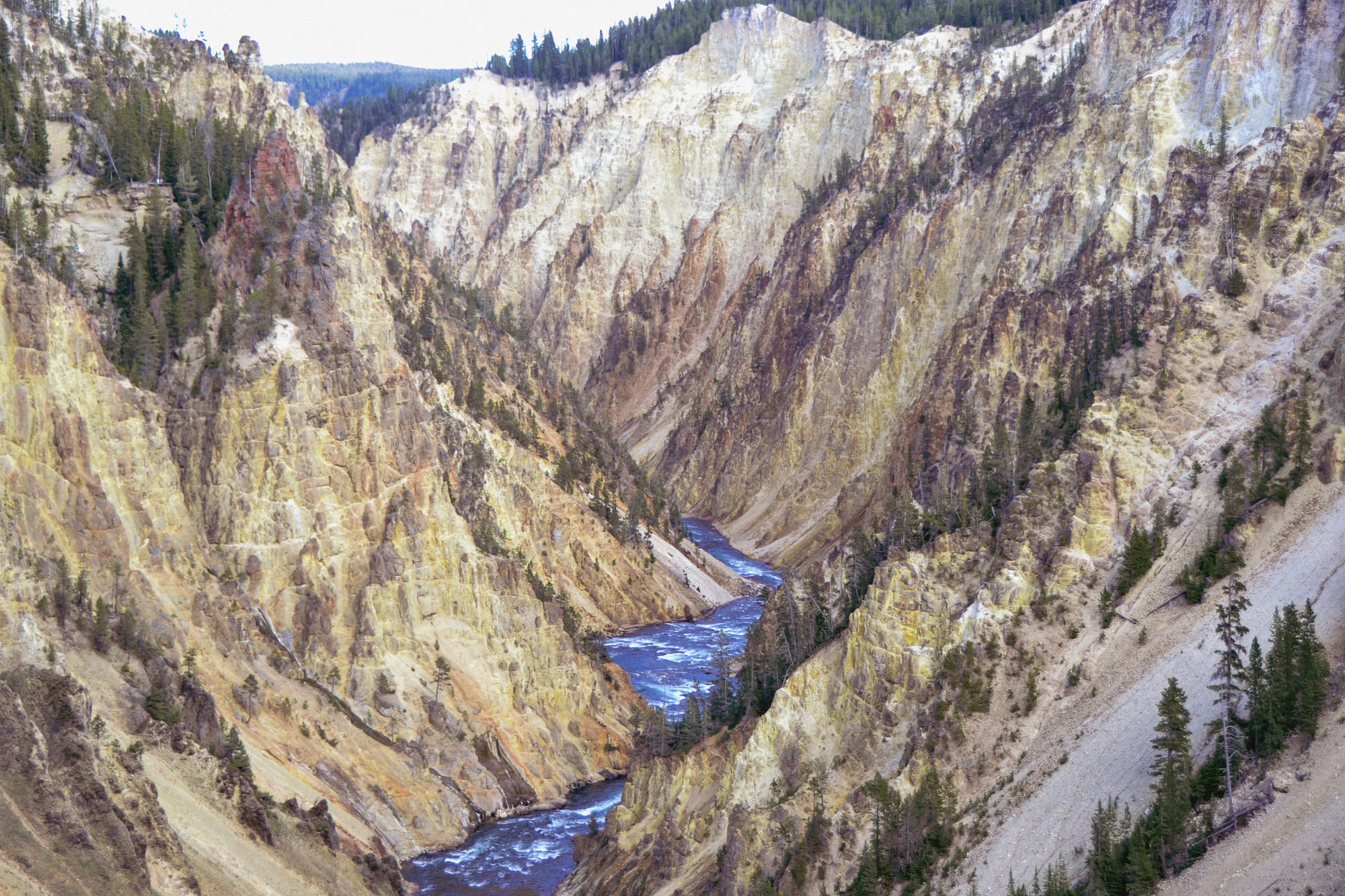
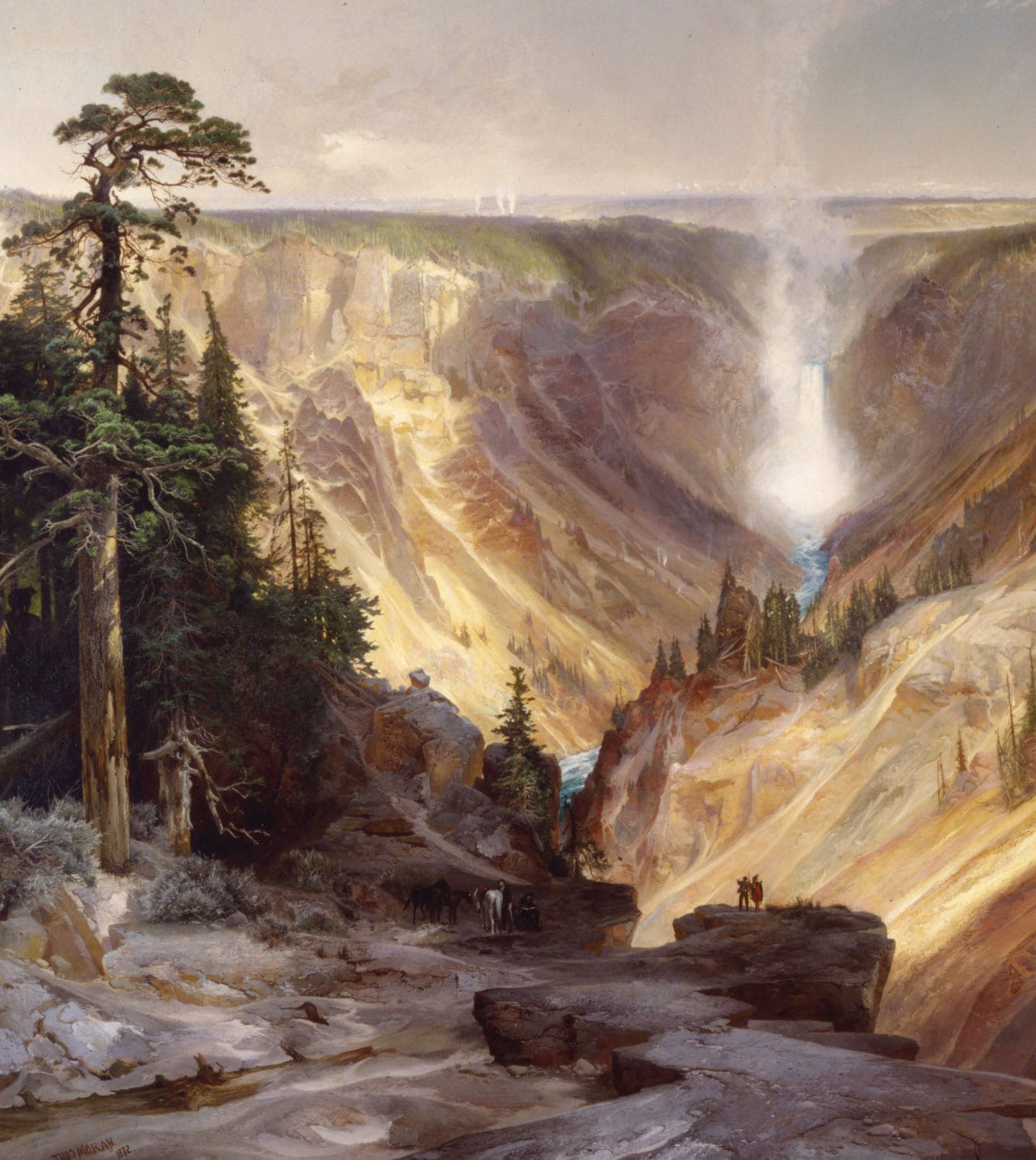
My photo of the Grand Canyon of Yellowstone & a Thomas Moran Painting from 1872 (https://bigskyjournal.com/images-of-the-west-thomas-moran/)
The sublime was something that took hold of the Romantics, and their art reflected on nature’s uncontrollable power through representations of man’s struggle with nature’s dominion. They prioritized emotion and subjective experience over intellect and logic. While I’m not going to argue against intellect and logic, I am going to argue that perhaps it is the emotion, beauty, and detail of everyday life that we are missing. The feeling of place, in our spaces. It is difficult to grapple with our smallness when we’ve lost the details of everyday life that make trivial moments so significant. Maybe that’s why people seem to think that destruction in the name of advancement is beneficial. When really, it’s just another way to show dominion instead of refusing the reality that we are not in control, that there are forces acting that are much larger than us.
There is such beauty in the mundane, but we are so quick to adapt to our surroundings that we forget to pay attention. Even after a couple of days walking around the geysers, I started to become less impressed by them. Which I think only goes to show the impact our consumerist society has on our everyday lives. That even when you are standing in the presence of a spectacle, of something you’ve never seen before, you start to think, yeah, okay, but what’s next? The impression that Yellowstone leaves on you is to slow down. Because at every turn, in every corner, amongst every horizon, is something worth stopping for.
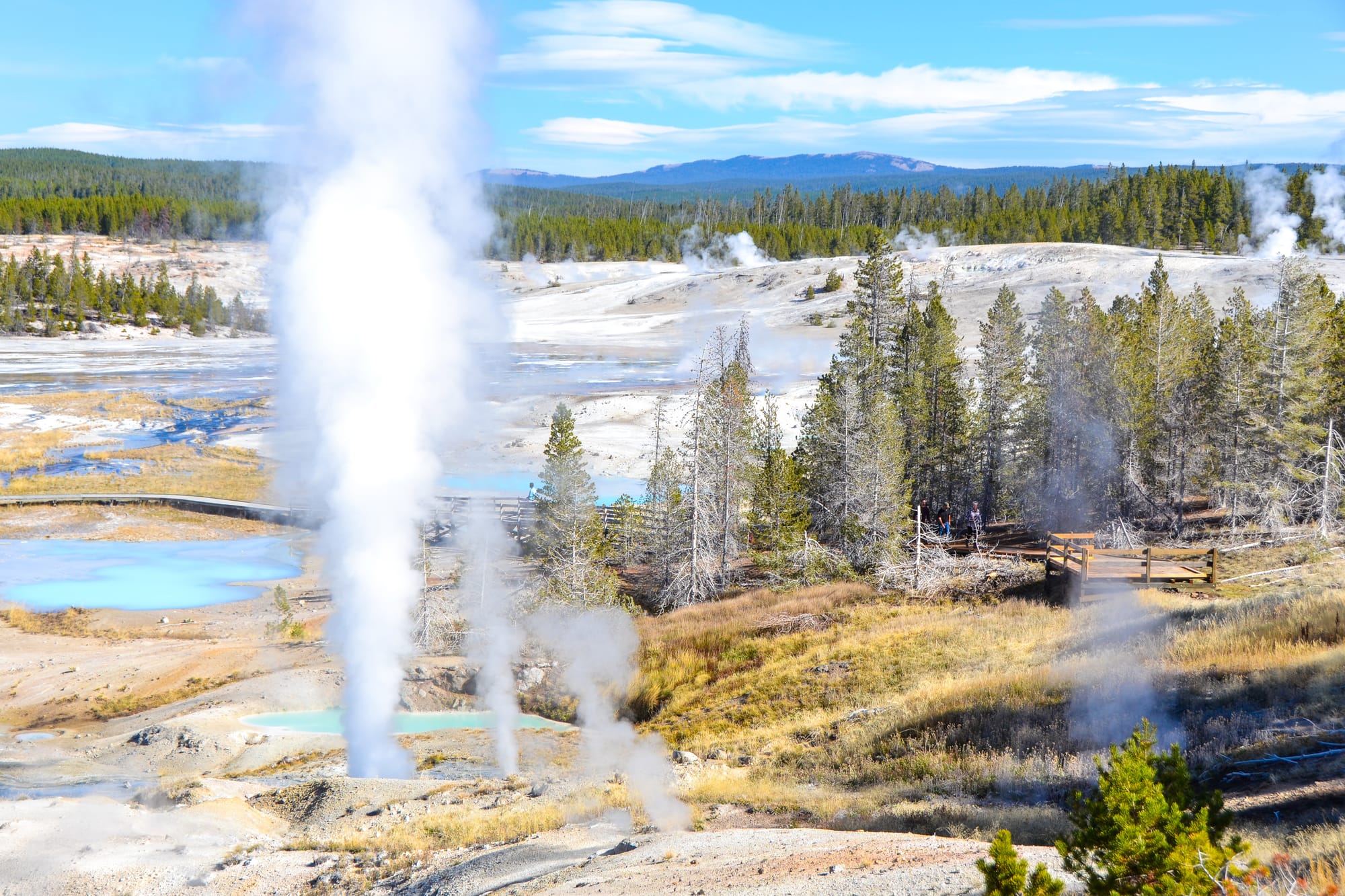
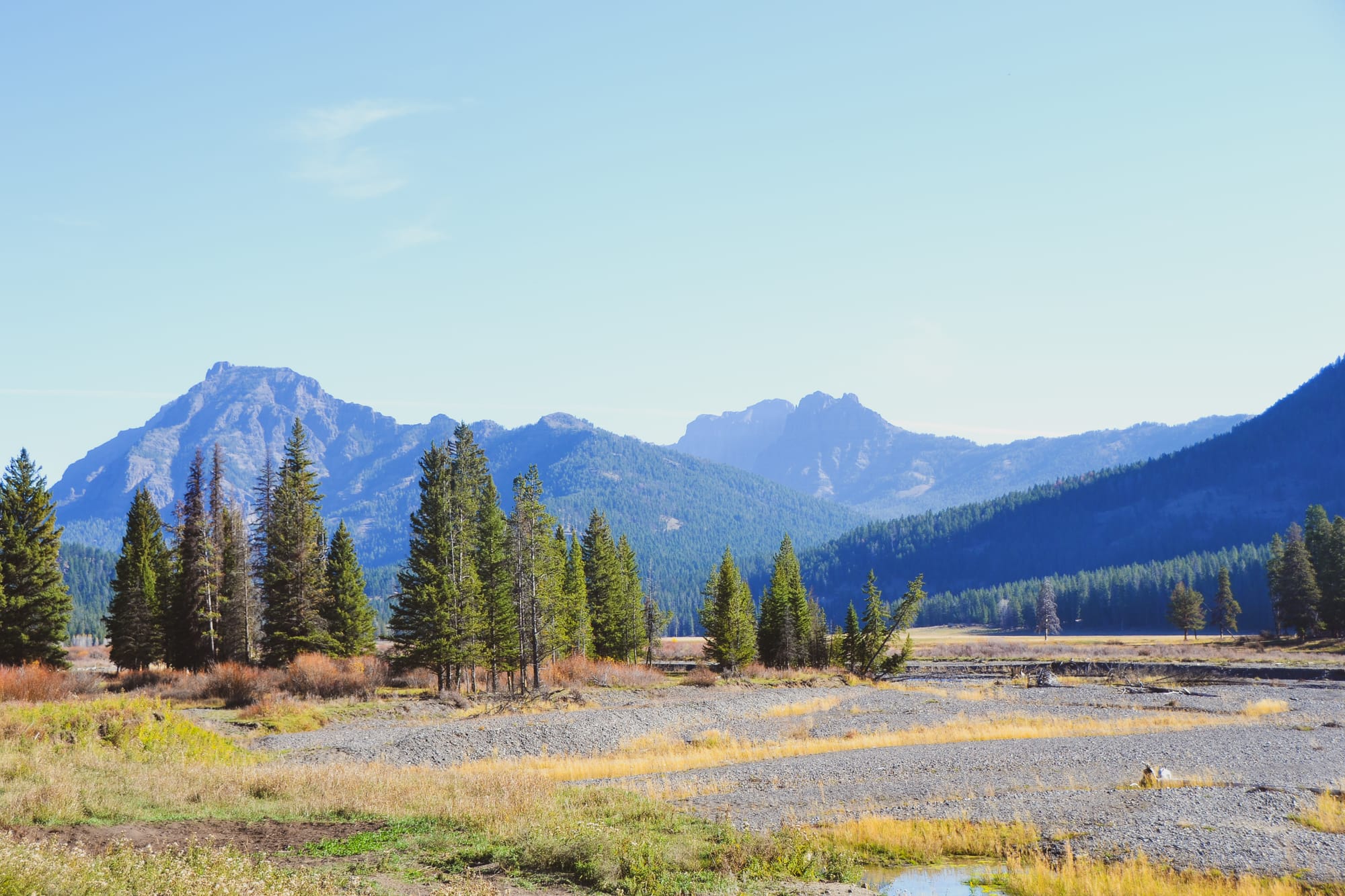
The vastness of the park is not threatening; it’s inviting and welcoming. Truly connecting to nature can allow you some comfort in existence. Because while we are in control of our actions, we lack control in the grand scheme of things. And isn’t that lovely? Isn’t that liberating? I returned home at ease and with a box of chocolates I picked up on my layover in Minneapolis from Minnesota’s finest chocolatier, Abdallah. What sticks with me now is not the sights or the information I gathered, but the feeling imprinted on me. Nature is a force to be reckoned with.
Always cite your sources :)
Galitz, K. C. (2004, October 1). Romanticism - the metropolitan museum of art. Metmuseum.Org. https://www.metmuseum.org/essays/romanticism
Old faithful geyser (U.S. National Park Service). (n.d.). Www.Nps.Gov. Retrieved October 23, 2026, from https://www.nps.gov/places/old-faithful-geyser.htm
Park, M. A. P. B. Y. N., & Us, W. P. C. (2023, October 11). Historic tribes - Yellowstone National Park (U.S. National Park Service). Www.Nps.Gov. https://www.nps.gov/yell/learn/historyculture/historic-tribes.htm