Infinity is a closed loop; everything comes back to you
Life is full of trade-offs, and we often tell ourselves that nothing is free. The “no free lunch” phrase comes from a time when bars in America would give “free” lunch to people who had purchased a drink. The food wasn’t free; they were still paying for it through their drink. Thus, “there is no such thing as a free lunch.” To get something we must give something else. But maybe this very three-word phrase prevents us from experiencing freedom. If we are to believe that nothing is free, then existing within that belief is a fixed understanding that our life costs something. While that cost is so often determined by external measures, it is defined by us internally. Of course, how the definition is determined, or how we determine the definition, depends on a myriad of factors. Nonetheless, we understand life is costly, and that each passing day is worth something to us.
There's been a longstanding sense that freedom is something to be earned. However, this only resonates in this way because freedom was withheld for so long by certain groups of people, and as more people “gain” freedom, the further away it seems. We see the physical manifestations of freedom in our lives through various rights, such as voting, marriage, work, education, standard of living, etc. These rights simultaneously serve as avenues for limitation, as those who are denied or cannot access these rights are less free than those who can. When freedoms are denied to someone, then their life becomes defined by what was determined for them. For those who experience freedom, they will determine how their life, and others', are defined. This highlights the difference between those who have been entitled to their freedom and those who have had to earn it.
Because we believe in freedom, we believe in everything that limits us from experiencing it. While physical freedoms tell us something about financial, political, and cultural freedom, they do not tell us of the internal processes that prevent one from being free. Our minds and bodies limit us too. Nothing is free because everything faces limitation. There is only so much time and space for our lives to happen. Because of this, everything is a choice, and thus, a trade-off. If the universe is to be closed, then there is a finite amount of energy, and a finite amount of outcomes for each possibility. In line with our established understanding that matter itself cannot be created or destroyed, we know that everything must become something else. The past is then present in everything, and while everything departs us, nothing leaves us.
On the flip side, we tell ourselves that the best things in life are free to us. Even then, are we ascribing a condition to freedom? Thus, it depends on how we choose to view our situation and whether we ascribe fated circumstances to our lives. If something is to come freely to us, it would mean it comes with no attachments, that it is boundless in reality until it finds us. However, it would also mean we have to let those things go as to not interfere with their independence. So, as all things meet their limitations, like recycled plastic, they become something new, and like water, we must let them flow.
Perhaps it is us in the pressure we place on things to mean something that prevents freedom, and for us, change becomes our greatest limitation. When we refuse to accept change, we are not letting the natural progression of existence take place. We do not prevent caterpillars from becoming butterflies because we know their process. So, how come when we are in our cocoon phase, we do not trust the process of our own becoming? Everything meets its limitation before it becomes something else. Endings are beginnings. But freedom itself is peculiar because it appears to be boundless. If something is truly free, it has no limitations; it is unbounded by any other thing.
Few things then can be free at all, because all things are a result of some other thing. We do not arrive at today without yesterday, and we do not become the person we are without the actions of our past. Our thought patterns shape the ideas we have of ourselves, and our environment shapes our understanding of the world. Everything is dependent on something else that came before it. This is not to say our outcomes are predetermined, but that they are dependent on us taking some action. Through this understanding that all things are continuous and bound to what came before them, we realize that most of life takes place in the middle. It is in the grey areas when we don’t know what we’re doing, or where we’re going, that it becomes so clear to us that life does not pause. It keeps going. We maintain life’s cycles; we uphold some that are outdated, and as they drift into a distant past, we make space for a new future to unfold. But it is only when we let there be space, a gap in our knowledge of what’s to come, that something new can actually be realized.
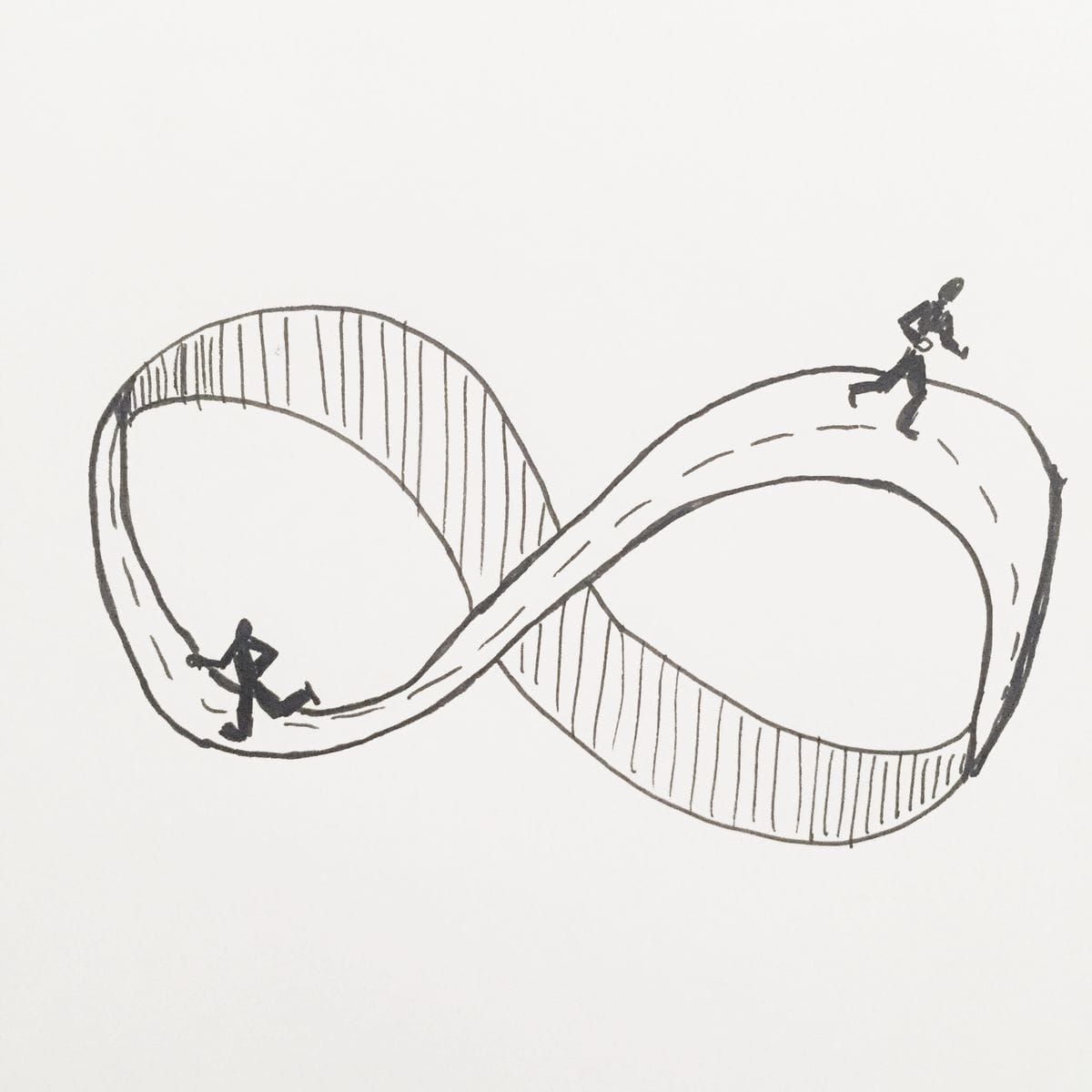
Nonetheless, the second we decide on a future, we see it become the past. The unknown immediately becomes the known as the gap in space we held for something new shrinks. For all of our futures are rooted in some decision made in our past, and all of our pasts are rooted in some hope for the future. Continuing to make choices demonstrates an understanding that tomorrow will come. It is when we stop, or are kept from, making choices that our freedom and future diminish. We should, however, find solace in choice itself. That it is free-flowing choice unbounded by an outcome that affords us freedom. We live in a continuous loop with possibilities expanding from each decision point, and it is this idea that our outcomes are endless, infinite, that creates their very bound. Infinity is a closed loop; everything comes back to you.
"There is no such thing as freedom, what can we do?"