In the Pursuit of Life

Each of us exists in the state of pursuit. Whether one is able to pursue living, over surviving, is dependent on both the context in which they’ve come to be, as well as the actions they’ve chosen. After all, life unevenly distributes fairness. So, it is then left to the common good to evaluate their means, and the means of others, to understand the life they share. That a person surviving is not experiencing life differently from the person living. It is true that no one person is any more deserving of a life lived than a life survived than the next. Of course, these definitions will vary depending on previous circumstances, but we can agree that among the existing not everyone is granted the opportunity to live. In this agreement, we can then understand the responsibility it grants to humankind, that each of us must seek justice for those who have been undermined by power, that we meet one another with friendliness first and skepticism last, and that we put our humanity first.
This needn’t be done in a courtroom, but in the daily lives we lead. That the surviving deserves to also be the living shouldn’t be a controversy worth debate, but the standard upheld by all. It should be a goal that everyone is gathered around and striving for. If you disagree here, you are disagreeing that people deserve a chance at life, and you might evaluate why you’ve gained that perspective. For there are two routes that bring you to that conclusion. First, that the lives of others are not your responsibility. But aren’t they, though? Do you not rely on others to sew your clothes, grow your food, and check you out at the grocery store? Do you not belong to a society in which all of our lives are interdependent on each of us showing up for one another? Second, it may be an assumption that your worth devalues when the worth of others rises. However, logic is lost upon this assumption as raising the floor inevitably raises the ceiling, while raising the ceiling only widens the gap between them. Nonetheless, I’m not here to argue.
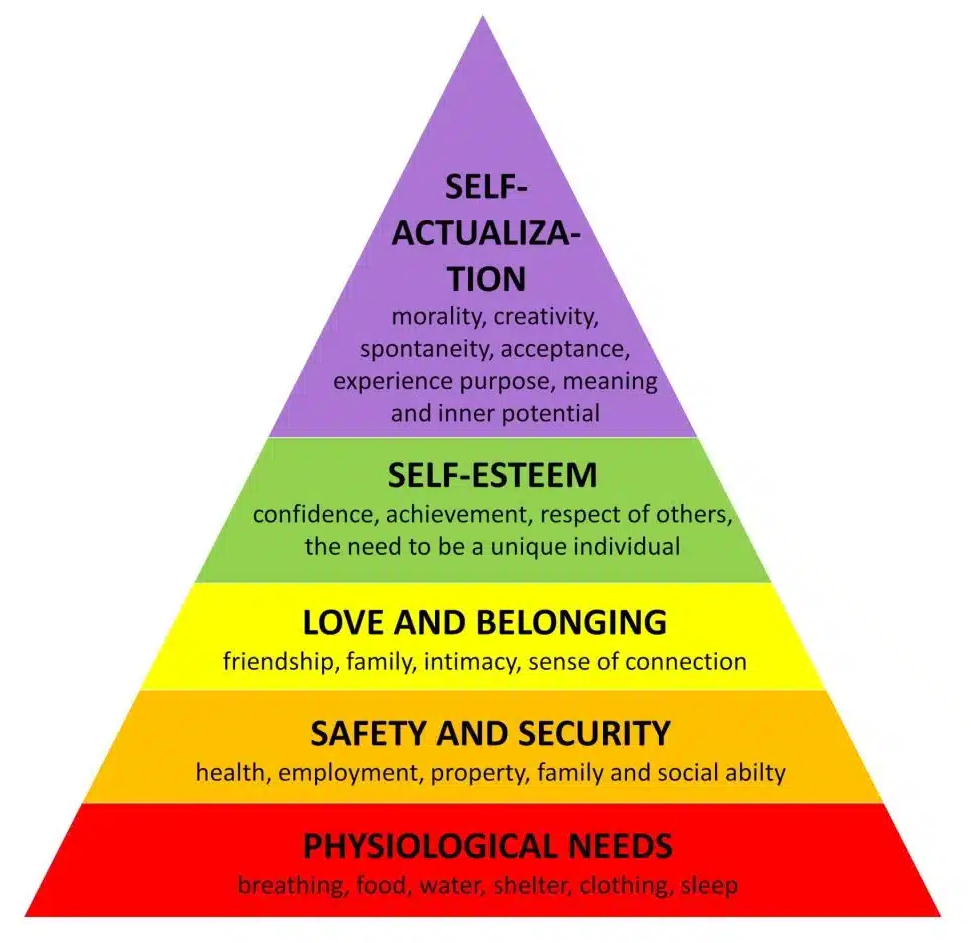
So, we must, together, alleviate the burden of the modern world that makes it so difficult to be of the living. It seems we are in need of a reminder of Maslow’s Hierarchy of Needs. The basic needs of an individual, their physiological and safety needs, are found at the bottom of the pyramid. Meaning, they are the first and foremost needs that must be met. This does not mean one cannot reach self-actualization without them, but that it will be significantly more difficult, unequal, to reach higher up the pyramid when one is worried about their basic needs of food, water, shelter, healthcare, and employment.
However, this inequity began with land ownership, where those with land had the means to grow food, have shelter, and most times, employment through farming. In the United States today, “private individuals and corporations own approximately 60% of land in the United States,” and unsurprisingly, “the five top landowners, who are all white, own more acres of land than all Black Americans combined” (Zarook, 2018). It is not that people should not have space of their own, but that everyone should. It is that the basic needs of every individual should be met, without argument, because everyone deserves them to be.
Now that we understand what is required to be in the pursuit of life, we might further understand how this pursuit is shared amongst us, the existing. Whether one is an animal hunting their prey, a tree turning its leaves to the sun, or a person growing their garden, everyone is pursuing life. For modern-day humans, there is a level of hope required for the future, but also the knowledge that it will someday arrive, to grow a garden. That we educate ourselves and choose activities that will take time to see improvement exemplifies our ability to plan ahead. We expect the future because we remember yesterday. So, when we consider our pursuits, it is essential to first consider today. For it is the things we do in the present that shape our expectations of the future.
The purpose for it all remains in our pursuits. Who we want to become tells us more about the person we are than it does about the person we become. Yet even once we become our pursuits, our striving to live does not meet an end. It is through the careful consideration of the past, present, and future that informs us of our satisfaction. Our load is only lightened when we choose to accept the life we live. Incidentally, it is through this acceptance that we stumble across the bridge of becoming our pursuits. Through the reflection of who we are, and were, on the way to who we will be, allows for the gap to be bridged. Acceptance will struggle to be met without the reflection of progress, or lack thereof, on the road to who we will be. So, it remains in our actions of the present that craft our future, and embodying the person we desire to become is nothing more than a decision made today.
However, consequently, this acceptance can also lead to stagnation. That the world will change can be expected, but whether we change with it is left to us. To seek improvement in character, in understanding, is the largest unifier of the past with the future. When we view the world as ever-changing, and us as part of the evolution, we determine for ourselves our own progress. Watching the world change with no intention of evolving oneself, then they may expect to remain the person they were without becoming the person they can be. What becomes of a life is dependent upon both the pursuits of the individual and the collective. Because life is something shared, for it to be improved upon requires the work of all.
Characteristics of Life
To be in pursuit of life, one must acknowledge what it is that they are in pursuit of and why they are in pursuit of it, so that they may deliver their life force (internal life) to the experience (external life). However, in order for this to be possible, for one to have the capacity to consider their own life force, they must acknowledge the characteristics of life. For our purposes, a characteristic is something we might consider typical of life. Since what is typical can be so wide-ranging and dependent on a multitude of factors, we will need to consider these more broadly. Characteristics of life can be thought of as abstracts; these are: coincidence, dreams, memory, and imagination, as all three of these may seem to belong to a realm beyond us. It is true, however, that we must exist within these realms to some degree in order to experience them. We fall to sleep and drift in and out of the waves of consciousness, and in our waking beta brain wave state, we share with one another the adventures of our unconscious. Likewise, when we plan for the future, we put to use the ability to place ourselves in circumstances other than our present. We can imagine future conditions for ourselves.
So then, isn’t it peculiar that death is not something experienced and reported back on? It is a part of life for the living, but not in the way that life is experienced internally and externally of us, where life is both the force of the animate (internal) and the experiences that take place (external). It is something outside of life, something that life waits for. Maybe it cannot be a characteristic of life because it cannot be experienced by the living, since the force that animates us and is shared amongst us diminishes in death. Perhaps it is because death does not exist but only to the living. Anyhow, we will stick to the four previously established characteristics of human life: coincidence, dreams, memory, and imagination. As each of these characteristics plays a vital role in the pursuits of the living.
Coincidence
Coincidence is life at work. It is the meeting of the life internal and life external through the active participation of both parties. For this reason, coincidence requires one to be actively delivering their life force to their experiences. When the two meet, we can recognize life at work because it is the external and internal collapsing into one another. It is the universe winking at you. Choosing to accept this nod opens you up to noticing more of them. Meanwhile, brushing it off closes you off to them. We might also consider coincidence to play the part of the becoming. When the external and internal are synchronized for a moment, one can understand that they are in the process of becoming. That the efforts of their life force are matching the external can serve as an indicator that the two are meeting as one. Wink back.
Dreams
Dreams serve as the unconscious of becoming. While there is no significant relation between dreams and what happens in reality, it is a time for our being to exist in a free-flowing state, separate from the awakened processing state. Throughout the day, we are constantly taking in information about our environments, and our unconscious state is processing the information and discarding what isn’t needed. When we sleep, the brain cleans out waste that builds up when we are awake. Inadequate sleep disallows for this process to occur, and waste, excess proteins, build up where “excess proteins and other molecules that can be toxic if not removed. Among those proteins are amyloid beta and tau, key drivers of Alzheimer’s disease,” (Denworth, 2025).
It is during REM sleep, rapid-eye movement sleep, where our eyes are moving behind the eyelids and brain activity is similar to when we are in a wakeful state (Cleveland Clinic, 2023), that dreams take place. They are, in other words, our unconscious lives that we are catapulted into. When we exist there, we are living a life not unfamiliar to us, but strange to us, because it is a series of information that we choose to narrate to ourselves. We take the meaning from our dreams and apply them to our lives. It is not that the dream can predict something, but that it might provide insight into your conscious life. For instance, anxiety dreams, like all your teeth falling out, tell you something about your state of being (anxious) and are not a literal warning to glue down your teeth.
When we awaken from a dream, or from a dreamless slumber, we can use the feeling we have upon waking as an indicator of our unconscious, to what lies underneath our process of becoming. Though in our dreams we forgo cognitive control, our state of consciousness is present. Sometimes, our dreams confront us with the emotions we override with cognitive control in our waking state. For our life to synchronize, our state of being must match. The unconscious can be used to our advantage to understand our current underlying state.
Memory
While sleep enables our memory to remain intact, we can consider memory to be the mark of becoming. Without it, we wouldn’t be adequately able to differentiate how far along we’ve come in the process of becoming. That we make our lives what we want them to be requires that we acknowledge our past and apply it to the future. Our memories serve us well in allowing us to consider our decisions of the past, and their outcomes, when we are evaluating a new set of options. Making the same decision with a different outcome in mind signifies the progress of one’s ways. They are stuck in them. For a different outcome, a different decision must be made.
Imagination
Where dreams are the unconscious of becoming, imagination is the conscious of becoming. It is the active idea of becoming by considering oneself in different situations. We imagine our futures before we live them. Though they do not always bear fruit in the way we’ve sown them to, the future is something beyond ourselves, and it takes the precaution of our memory, and the indication of our state, to be shaped. When we imagine ourselves leading a certain life, we plant the seed for ourselves to grow into it. Because life takes work, we cannot expect daydreaming without action to wind us up where we imagine. Our imagining must be accompanied by intention and action. Putting thought into action puts energy into motion (emotion) and changes our state of being.
By coming to know and pay attention to these abstract characteristics of life, one builds their capacity to use their life force. Because life is fluid, existing outside of oneself, one is constantly applying their force. Once aware of these characteristics, one forms a relationship to the life internal and the life external. The awareness of this force comes through the triad meeting of one’s consciousness, the life internal, and the life external. Where they meet determines an abstract placement on their way to becoming. A starting point. To know where one is in space and time is the first step to this awareness. And to know their starting point, one may look at what they are choosing.
What Are You Choosing?
Whether one is aware of the characteristics or the influence of their own life force, they are participating in choosing their life, all the same. While our state of pursuit varies, and fairness remains unevenly distributed, and not all choices are presented equally, choice is nonetheless omnipresent. Injustice is present in choice, however, when a choice is made for someone. Choice is the demonstration of freedom, and without it, freedom ceases to exist. Yet we remain captive to our own choices. By not making a choice, we leave it up to chance (the life external) or to someone making it for us. But choice doesn’t need to weigh so heavily because it is freedom. We ourselves cannot collapse under the weight of freedom because choice itself is already not entirely free. For it is brought to us by the circumstances of our present, and the outcomes of choice are limited by our expectations of what they will bring. So, when we choose, we are not evaluating the weight of our choices but the weight of our expectations. In which case, we are maximizing our ability to have one experience over another. What is it, then, that you are choosing?
Through our pursuits, we come to meet people and places that agree with us and that don’t, and that we wouldn’t have met otherwise, because life requires active participation. It is not that these things happen for a reason, but because we decided to be intentional about our actions. Our progress is measured by the tools we decide to measure with. Because life is dependent on us pursuing it and contributing to something greater than ourselves. Nonetheless, life itself is instinctual, as the bees pollinate the plants; it is our consciousness that must be applied to give our instincts a direction. Life will flow and will make no choices itself. For trillions of years, existence has followed a natural path of evolution, making no choices. It is the intervening of consciousness, of awareness, that makes alterations. It is the decision of the individual to intervene in the direction of their life.
Since the force of life is something shared, each of these characteristics exists beyond the individual level as they are present in the collective. Together, we imagine a future, remember the past, have the same common dreams of being chased, falling, and flying, and it is through each other that coincidences happen. A stranger can do, or say, something that resonates so deeply with us. It’s happened to us all. In any conversation, we look to relate to the other. We use our lives to find a relation within someone else’s life, and often, we can find it. Through the power of language, we discover that our experiences aren’t so different. So why is it that people seem so prepared to disagree with strangers rather than to understand them? The lives we cross are all sharing something in common with ourselves at the same space in time. Everyone knows something about the human experience that you don’t, because while we all share in life, we don’t exist in it the same. Everyone has something they can teach you, because while life is shared, the perspective is unique.
So, we can choose to approach the lives of others with the acknowledgment that we don’t know much about their trials and tribulations, but that we have some degree of relation to their experience. That common ground exists and is present for us all to find. Nonetheless, our commonalities bring us together when we choose to attend the same event, and even those we share in these experiences bring things we might disagree with. But these are irrelevant when we disappear into the synchronicities of a crowd, to slap, sing, and dance together, we are, for a moment, behaving as one. I don’t believe there’s a reason for existence, but if I did, I’d be inclined to believe that it’s to meet one another with love, to respond with love. Then we might recognize that our unity through synchronicities resembles the original state of oneness from which we all stem. It is a choice to be divided just as it is a choice to divide.
We’re all in the pursuit of life, together.
Capes, Kacy. “Maslow’s Hierarchy of Needs in Education | Brooks and Kirk.” Brooksandkirk.co.uk, 2024, brooksandkirk.co.uk/understanding-maslows-hierarchy-of-needs-in-education/. Accessed 30 Dec. 2025.
Cleveland Clinic. “Sleep.” Cleveland Clinic, Cleveland Clinic, 19 June 2023, my.clevelandclinic.org/health/body/12148-sleep-basics. Accessed 30 Dec. 2025.
Denworth, Lydia. “How Sleep Cleans the Brain and Keeps You Healthy.” Scientific American, 19 Aug. 2025, www.scientificamerican.com/article/how-sleep-cleans-the-brain-and-keeps-you-healthy/. Accessed 30 Dec. 2025.
Zarook, Ruqaiyah. “Map of the Week: Mapping Private vs. Public Land in the United States | UBIQUE.” Ubiqueags.org, 2018, ubiqueags.org/map-of-the-week-mapping-private-vs-public-land-in-the-united-states/.
Member discussion